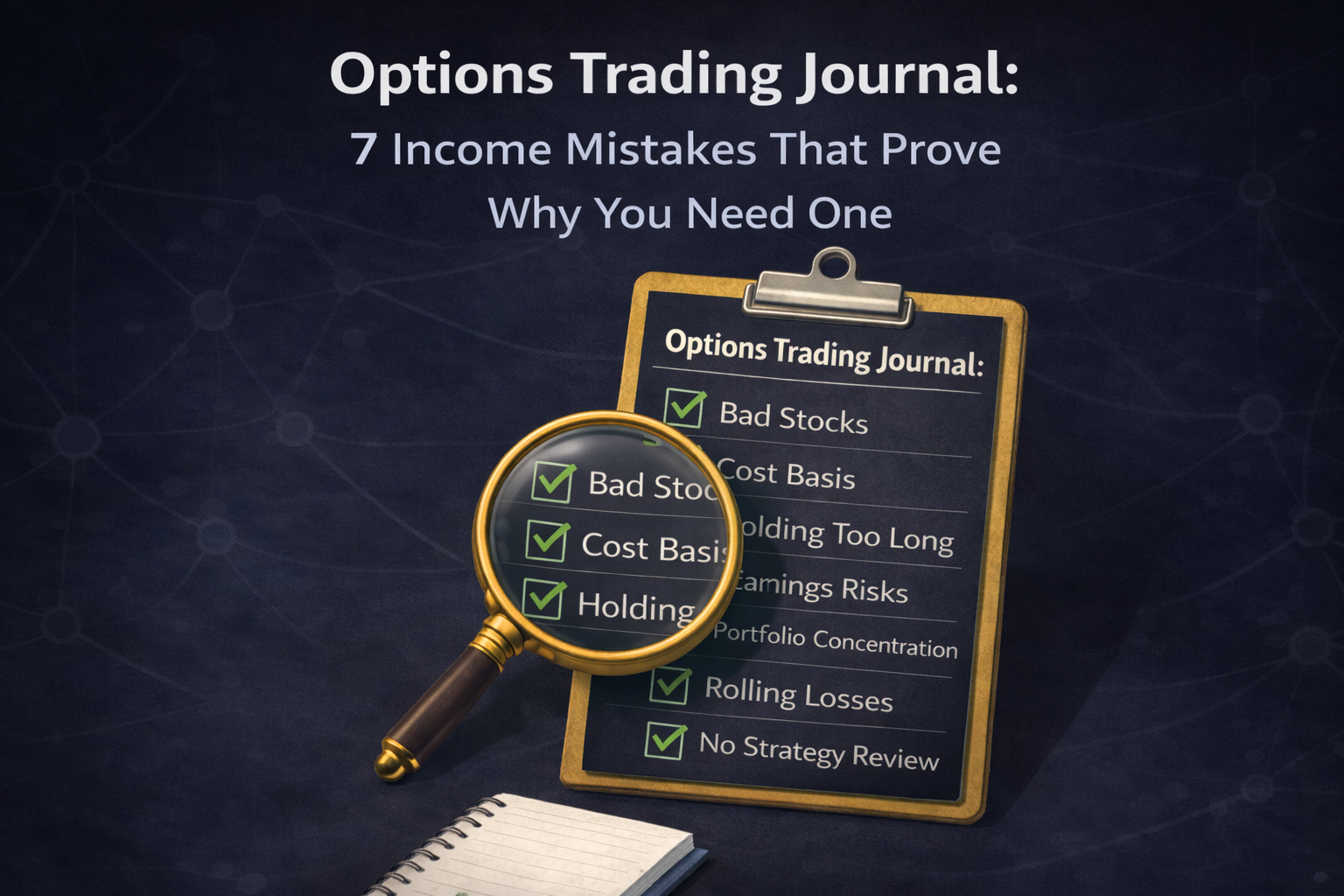
Options Trading Journal: 7 Income Mistakes Every Option Seller Should Track
Most “options mistakes” articles tell you to have a trading plan and not enter the wrong order. That’s fine for someone buying their first call option.
This isn’t that article.
If you sell options for income — cash-secured puts, covered calls, wheel strategies — the mistakes that actually hurt you are quieter. They don’t blow up your account in one trade. They erode returns over months, hiding in fragmented broker statements and scattered P&L data.
This applies whether your option trading journal lives in software, Notion, or a Google Sheets template.
The worst part: you won’t even notice most of these patterns without a system to track them.
If you want to track options trades without stitching together spreadsheets, OptionIncome is built for this exact workflow.
Here are 7 mistakes specific to income sellers, and for each one, what a journal would have revealed before the damage compounded.
Not investment advice. Options involve risk of loss. These examples are for educational purposes only.
Mistake #1: Selling premium on stocks you wouldn’t want to own
This is the foundational mistake — and the most expensive one over time.
What it looks like
You scan for high-IV names because bigger premium = bigger income. You sell a cash-secured put on a biotech stock at $35 because the premium is $2.80 (8% return in 30 days). The stock drops to $28 on a failed trial result. You’re assigned, holding shares you never wanted, down $4.20/share after premium.
Meanwhile, the boring $0.90 premium CSP on a stock you actually wanted to own expired worthless. Again.
Why it costs income sellers specifically
Day traders can cut losers fast. Income sellers who get assigned are now stockholders — and if you don’t want to own the shares, every day you hold them feels wrong. You panic-sell at the bottom, or worse, you sell covered calls below your cost basis trying to “make it back.”
What your journal reveals
When you filter your analytics by symbol, a pattern appears: your biggest losses cluster around 2–3 high-IV names you picked for premium, not conviction. Your win rate on those names might even be decent (7 out of 10 trades profitable), but the 3 losers wipe out the gains from all 7 winners.
The fix is visible in the data before you feel it in your account.
How to review performance by symbol →
Mistake #2: Ignoring your effective cost basis after rolls and assignments
What it looks like
You sold a $48 cash-secured put on XYZ. Stock dropped, so you rolled down to $46 for a small credit. It dropped again — you rolled to $44. Eventually you were assigned at $44.
Your broker shows a cost basis of $44.00 (the assignment strike). But your actual journey was:
- Roll 1: closed $48 put at a loss of −$1.80, opened $46 put for +$0.60 credit
- Roll 2: closed $46 put at a loss of −$1.40, opened $44 put for +$0.50 credit
- Assignment at $44, original premium collected: $1.20
True effective cost basis: $44.00 + $1.80 + $1.40 − $0.60 − $0.50 − $1.20 = $44.90
Your broker says $44. Your real cost is $44.90. Now you sell a covered call at the $45 strike thinking you’re above your cost basis — but you’re actually only $0.10 above it. One more roll and you’re underwater without realizing it.
Why it costs income sellers specifically
Income selling generates dozens of small premium transactions over time. Each roll, each assignment, each covered call premium shifts your real cost basis in ways your broker doesn’t aggregate. After a few wheel cycles, the gap between what your broker shows and your actual position can be several dollars per share.
What your journal reveals
A journal that groups related trades into campaigns shows your adjusted cost basis including all premiums and roll debits in one number. No spreadsheet math, no guessing. You know exactly where your break-even is before you set your next strike.
Wheel strategy cost basis tracking →
How assignment affects your cost basis →
Mistake #3: Holding winners too long (chasing the last 20% of premium)
What it looks like
You sold a covered call for $1.50 with 30 DTE. After 10 days, the call is worth $0.30 — you’ve captured 80% of the premium. But you think: “Why pay $30 to close when I can wait 20 more days and keep the full $150?”
Three days before expiration, the stock spikes on sector news. Your call goes from $0.30 back to $1.80. You close at a loss — or worse, get assigned and give up shares you wanted to keep.
Why it costs income sellers specifically
The math on this is brutal when you run the numbers across a year of trades:
- Closing at 80% after 10 days: $120 profit, capital free to sell a new call
- Holding to expiration for the last 20%: $30 more profit (if it works), but 20 more days of risk exposure
Your annualized return is almost always higher by closing early and redeploying. But without tracking AROI (annualized return on investment), you can’t see this — it just feels like leaving money on the table.
What your journal reveals
Sort positions by P&L percentage. When you see a position at 70–80% profit with 15+ DTE remaining, the data makes the decision obvious: close it, redeploy, and let compounding do the work.
Over time, your journal shows that your early-close trades have higher annualized returns than your held-to-expiration trades — even though each individual trade captures less total premium.
Identify early closing opportunities →
Sort positions by P&L % and DTE →
Mistake #4: Selling covered calls through earnings without a plan
What it looks like
You own 100 shares of XYZ at $50 and sell a $53 covered call for $1.40 with 25 DTE. Earnings are in 10 days. You figure the premium is juicy because of the IV spike — might as well capture it.
Scenario A: Stock gaps to $60 on a beat. Your call is deep ITM. You sell at $53, missing $7/share of upside. Total return: $3 + $1.40 premium = $4.40/share. The stock went up $10. You captured less than half.
Scenario B: Stock drops to $43 on a miss. You keep your $1.40 premium but you’re now holding shares down $7 with a covered call that’s worthless. The premium was a band-aid on a bullet wound.
Why it costs income sellers specifically
Earnings create binary outcomes that don’t fit the income seller’s edge. Income strategies work best in low-volatility, range-bound conditions where theta decay is your friend. Earnings are the opposite: high-volatility, gap-risk events. The inflated premium looks attractive but it comes with proportionally inflated risk.
What your journal reveals
Filter your historical trades by covered call strategy and look at your worst outcomes. If you’ve been selling through earnings regularly, you’ll likely find that your worst 3–5 covered call results all cluster around earnings weeks. The rest of your covered call trades are consistently profitable.
The pattern is invisible without the filter. With it, the fix is obvious: close or roll before earnings, then re-sell after the event.
Mistake #5: Over-concentrating wheel positions in one sector
What it looks like
Your portfolio looks diversified: you’re running wheels on AAPL, MSFT, NVDA, GOOGL, and AMD. Five different stocks. Five different wheel campaigns.
Then tech rotates. All five positions move against you simultaneously. You’re assigned on 3 CSPs in the same week, now holding $50K+ in tech shares — all underwater — with no capital left to sell puts on anything else.
Why it costs income sellers specifically
Income sellers often gravitate toward the same pool of names: high-liquidity tech and mega-cap stocks with tight option spreads. This creates concentration risk that feels like diversification because the tickers are different. But from a sector exposure standpoint, you’re making one big bet.
When the sector turns, there’s no offsetting winner in your portfolio. Every wheel campaign goes into “recovery mode” at the same time, and your income generation stalls across the board.
What your journal reveals
A strategy breakdown by symbol shows you something your broker’s position list doesn’t: what percentage of your active premium is concentrated in one sector. If 80% of your open positions are in tech, you see it immediately — before the rotation happens, not after.
The fix isn’t complicated: add 1–2 positions in a different sector (healthcare, financials, industrials, consumer staples). The premium might be slightly lower, but the portfolio-level stability is worth it.
Analytics: performance by symbol and strategy →
Mistake #6: Rolling to avoid a loss instead of exiting a broken thesis
What it looks like
You sold a $50 CSP on a stock you liked. It dropped to $45 — you rolled down to $47 for a small credit of $0.40. It dropped to $40 — you rolled to $44 for $0.35 credit. It dropped to $36 — you rolled to $41 for $0.25 credit.
Each roll felt like “managing the position.” Each individual credit looked positive. But your rolling campaign P&L tells a different story:
- Roll 1 net: closed at −$2.10, opened for +$0.40 → net: −$1.70
- Roll 2 net: closed at −$1.90, opened for +$0.35 → net: −$1.55
- Roll 3 net: closed at −$1.60, opened for +$0.25 → net: −$1.35
- Still open, currently at −$2.00
Total campaign P&L: −$6.60 per share (−$660)
If you’d taken assignment at $50 when the thesis broke at $45 and sold shares, your loss would have been ~$3.80/share (strike minus premium minus market price). The rolling “saved” nothing — it doubled the loss and tied up capital for months.
Why it costs income sellers specifically
Rolling is a legitimate tool when the thesis is intact and you’re buying time. But income sellers often roll reflexively because each individual roll looks like it produces a credit. The broker shows “Roll: +$0.35 credit” and it feels like progress. The cumulative damage is hidden across multiple closed legs that nobody adds up.
What your journal reveals
A rolling campaign view groups all legs into a single P&L number. When you see −$660 total instead of a series of small credits, the decision changes. The question shifts from “can I roll one more time?” to “is this capital better deployed somewhere else?”
Track rolling campaign P&L →
When rolling makes sense in the wheel →
Mistake #7: Not reviewing performance by strategy
What it looks like
You run the wheel strategy and feel good about it. You’re collecting premium every month. Your account balance is roughly flat or slightly up. The wheel “works.”
But when you actually break down performance by strategy, a different picture emerges:
- Cash-secured puts: +$3,200 YTD (78% win rate, consistent premium)
- Covered calls: −$400 YTD (you keep getting called away below your cost basis, or holding through drops)
Your CSPs are carrying the entire portfolio. Your covered calls are a drag — but you never noticed because the broker shows all trades in one undifferentiated list.
Why it costs income sellers specifically
Most income sellers use multiple strategies (CSPs, covered calls, spreads) or at minimum run the two phases of the wheel. Each strategy has different performance characteristics. Without separating them, you can’t tell which part of your process is generating returns and which part is leaking value.
This is the difference between “I sell options” and “I know which options make me money.”
What your journal reveals
Filter by strategy type. Immediately you see:
- Which strategies are actually profitable (not just which individual trades)
- Where your win rate hides a problem (high win rate + low average win vs. large average loss)
- Whether your time is being spent on the right strategy — maybe you should sell more CSPs and fewer covered calls, or vice versa
This is the single most actionable insight a journal provides, and it takes 30 seconds to see once the data is structured.
Analytics: filter by strategy →
Historical trades: strategy breakdown →
The common thread: you can’t fix what you can’t measure
Every mistake on this list shares the same root cause: the pattern is invisible without structured data.
Your broker shows you individual trades. A journal shows you the patterns across trades. That’s the difference between a trader who repeats the same mistakes quarterly and one who eliminates them.
The goal isn’t to journal for the sake of journaling — it’s to answer specific questions:
- Which stocks actually make me money? (#1)
- What’s my real cost basis? (#2)
- Am I closing too late? (#3)
- Are earnings killing my covered calls? (#4)
- Am I concentrated in one sector? (#5)
- Is rolling helping or hurting? (#6)
- Which strategy is carrying my portfolio? (#7)
If you can answer those questions with data, you’ll avoid most of the mistakes on this list before they compound. If you can’t, you’re trading blind — and the patterns will keep repeating.
FAQ
Can I use Google Sheets as an options trading journal?
Yes. A Google Sheets journal can work early on if you track strategy, symbol, premiums, assignment, and adjusted cost basis consistently. Most traders switch to a dedicated tracker once rolling campaigns and multi-ticker analysis become too manual. If you want templates to start from, here are free options trading spreadsheets.
What are the most common options selling mistakes?
For income sellers (CSPs, covered calls, wheel), the most common mistakes are: chasing premium on stocks you wouldn’t want to own, losing track of effective cost basis after rolls, holding winners too long, selling through earnings, over-concentrating in one sector, rolling to avoid losses on a broken thesis, and not reviewing performance by strategy.
Do I need a trading journal for options?
If you sell 1–2 options a month on the same stock, you can probably track performance in your head. If you sell options regularly across multiple tickers — especially if you roll, get assigned, or run wheel cycles — a journal becomes essential. The complexity compounds faster than most traders expect, and broker statements aren’t designed to show strategy-level performance.
What should I track in an options trading journal?
At minimum: premium collected per trade, effective cost basis after premiums and rolls, P&L by strategy type, P&L by symbol, win rate, assignment frequency, and annualized return on investment (AROI). The most valuable insight usually comes from filtering performance by strategy and symbol — which tells you where your edge actually is.
How often should I review my trading journal?
A quick position check (P&L %, DTE, delta) should happen daily or at least before selling new positions. A deeper strategy review (which strategies and symbols are working, concentration risk, rolling campaign health) works well on a weekly or monthly basis. The key is having the data structured so the review takes minutes, not hours.
Related reading
- Wheel Options Strategy: The Complete Step-by-Step Guide
- What Is a Covered Call? Complete Guide for Income Investors
- What is a Cash-Secured Put? Complete Guide for Income Investors
- Options Assignment Explained: What Happens, What to Do, and How to Track It
- Best Free Options Trading Spreadsheets (Covered Calls, Wheel, Journal)
Summary
The 7 mistakes that cost income sellers the most aren’t the dramatic ones — they’re the quiet patterns that erode returns month after month:
- Selling on stocks you wouldn’t own — your biggest losses come from names you picked for premium, not conviction
- Ignoring cost basis after rolls — your broker’s number is wrong after multiple adjustments
- Holding winners too long — the last 20% of premium isn’t worth the risk or the time
- Selling through earnings — binary events don’t fit the income seller’s edge
- Concentrating in one sector — five tech stocks is one bet, not five
- Rolling to avoid a loss — small credits hide large cumulative damage
- Not reviewing by strategy — you can’t improve what you can’t separate
The common thread: every one of these patterns is invisible without structured trade data. An options trading journal doesn’t just record what happened — it reveals the patterns that tell you what to change.