Selling Covered Calls: Covered Call Strategy for Income Investors
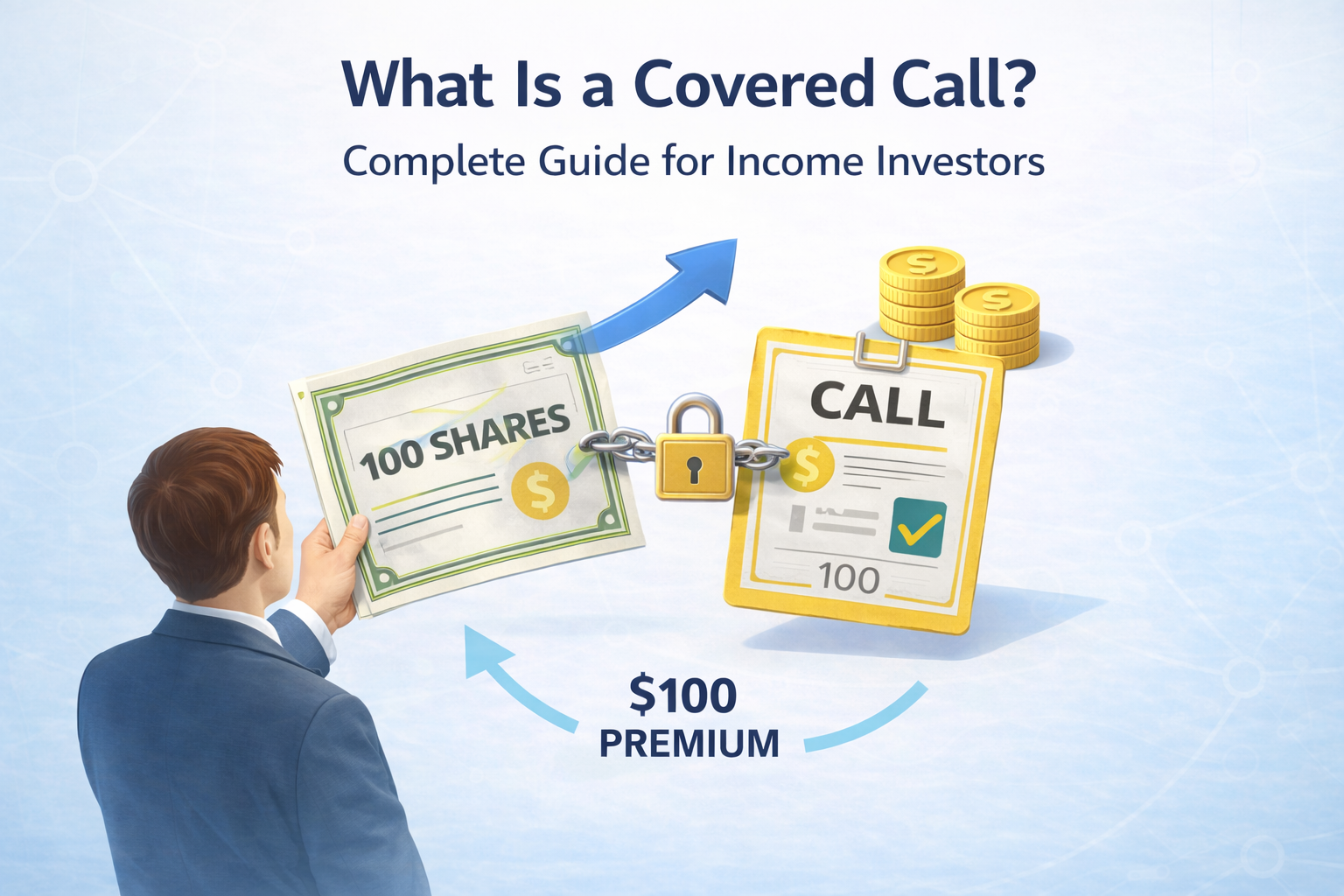
Selling covered calls means you own 100 shares of a stock (or ETF) and sell a call option against those shares. You collect premium upfront in exchange for agreeing to sell your shares at the strike price if the option is exercised.
People use covered calls to:
- Generate income from stocks they already hold
- Reduce effective cost basis over time through collected premiums
- Run the second phase of the Wheel strategy (cash-secured put → assignment → covered calls)
If you only remember one thing:
A covered call is “get paid to set a limit sell order on shares you already own.”
Quick example (with real numbers)
You own 100 shares of XYZ at $50.
You sell 1 call:
- Strike: $52
- Expiration: 30 days
- Premium received: $1.20 (=$120 total, since options are ×100)
Outcomes at expiration
-
Stock stays below $52 Call expires worthless → you keep $120 premium and still own your shares. You can sell another call next cycle.
-
Stock rises above $52 Your call is assigned → you sell 100 shares at $52. Total return: $2.00/share capital gain + $1.20 premium = $3.20/share ($320) You “miss” any gains above $52 — that’s the trade-off.
-
Stock drops to $46 Call expires worthless → you keep $120 premium. You’re still holding shares at a loss, but your effective cost basis is now: $50.00 − $1.20 = $48.80 (premium cushioned the drop by $1.20/share)
That’s the core covered call trade-off:
- Best case: you keep premium + shares (stock stays flat or rises slightly)
- Cap case: you sell shares at the strike + keep premium (stock rises past strike)
- Worst case: stock drops significantly — premium helps, but doesn’t eliminate downside
The payoff: max profit, max loss, break-even
For 1 covered call (100 shares + 1 short call):
Max profit
Your maximum profit is capped at:
- Max profit = (strike − stock purchase price + premium) × 100
Using the example above:
- Max profit = (52 − 50 + 1.20) × 100 = $320
This happens when the stock is at or above the strike at expiration.
Max loss
The worst case is the stock goes to $0:
- Max loss ≈ (stock purchase price − premium) × 100
- Max loss = (50 − 1.20) × 100 = $4,880
Your downside is similar to just owning shares, minus the small premium cushion.
Break-even price
Break-even at expiration:
- Break-even = stock purchase price − premium
- Break-even = 50.00 − 1.20 = $48.80
Selling covered calls: step-by-step
1) Own shares you’re comfortable holding
This is the most important rule — identical to cash-secured puts.
If you wouldn’t hold the stock without the call premium, a covered call turns into “collecting a small fee while bag-holding.” The premium should be a bonus on a position you already want, not the reason you own the shares.
2) Choose an expiration (DTE)
Common choices:
- 21–45 days: the sweet spot for most income sellers. Theta decay accelerates, and you can repeat the cycle frequently.
- 7–14 days: more premium per unit time if the stock cooperates, but requires closer management
- 45–60+ days: more premium per trade, fewer decisions, but capital is tied up longer
There’s no universal “best.” The right DTE depends on how actively you want to manage positions.
3) Choose a strike price
This is where your strategy gets defined:
- Out-of-the-money (OTM) strikes: lower premium, more room for the stock to appreciate before being called away. Most income traders start here.
- At-the-money (ATM) strikes: highest premium, but you’ll likely be called away if the stock moves even slightly up.
- In-the-money (ITM) strikes: maximum premium + downside protection, but you’re almost certain to be called away. More of a “sell with extra income” than an income strategy.
A practical way to think about it:
Your covered call strike is your limit sell price. Pick a price where you’d be happy to sell the shares.
4) Sell the call (“Sell to Open”)
When you place the order:
- You receive premium immediately
- Your broker will flag the call as “covered” (backed by your shares)
- The position can be managed before expiration (close early / roll)
5) Manage the position until expiration
You generally have three paths:
- Let it expire worthless (keep premium, keep shares)
- Buy to close early (lock in profit when most premium is captured)
- Roll (close current call, open a new one at a later date or different strike)
What happens at expiration (the three outcomes)
Outcome 1: The call expires worthless
Stock closes below the strike. You keep the premium and your shares. This is the outcome most covered call sellers are aiming for — income without giving up the position.
Next move: Sell another call for the next cycle.
Outcome 2: You close early (before expiration)
Many covered call traders close early if:
- They’ve captured 50–80% of the premium (why risk the last 20% for weeks of exposure?)
- Earnings or a catalyst is approaching
- They want to sell a new call at a different strike or expiration
Closing early is just: Buy to Close your short call.
How to identify early closing opportunities in OptionIncome
Outcome 3: You get assigned (shares called away)
Stock closes above the strike (or you’re assigned early). Your shares are sold at the strike price and you keep the premium.
This isn’t a loss — you sold at a price you chose, plus collected premium. But if the stock ran significantly past your strike, you’ll feel the opportunity cost.
Next move: If you want to stay in the position, sell a cash-secured put to potentially re-enter. This is the Wheel strategy in action.
What happens when you get assigned — full guide
Covered call strategy: strike selection trade-offs
This is the single most important decision in covered call selling. Here’s the trade-off in plain terms:
Closer to the money (higher delta):
- More premium
- Higher chance your shares get called away
- Less room for the stock to appreciate
Further out of the money (lower delta):
- Less premium
- Lower chance of assignment
- More room to participate in upside
Using delta as a guide
Delta gives you a rough probability of being assigned:
- 0.30 delta ≈ ~30% chance the call finishes ITM
- 0.20 delta ≈ ~20% chance
- 0.15 delta ≈ ~15% chance
Most income-focused covered call sellers target somewhere in the 0.15–0.35 delta range, depending on their view on the stock.
How to monitor position delta in OptionIncome
When to close early vs. let it expire
One of the most practical questions in covered call management: should you close the position before expiration or let it ride?
The case for closing early
If your covered call has captured 70–80% of its premium with significant time remaining, closing early often makes sense:
- You free up the position to sell a new call (potentially collecting more total premium)
- You remove the risk of a sudden move in the last days
- Your annualized return may actually be higher by closing early and redeploying
Example:
- You sold a call for $1.20 with 30 DTE
- After 12 days, the call is worth $0.25 (you’ve captured ~80%)
- Buying to close costs $25 to lock in $95 profit
- You can immediately sell a new 30-day call for fresh premium
The case for letting it expire
- If there’s very little premium left (say $0.05), the cost of closing may not be worth it
- If you’re fine being called away at the strike, just let it play out
- If the stock is well below your strike and the call is essentially worthless
A simple rule of thumb
Close early when P&L % > 70% and there are more than 7 DTE remaining. Let it expire when there’s minimal premium left and expiration is near.
Track P&L % and AROI on your positions
Rolling covered calls
Rolling means closing your current call and opening a new one — usually at a later expiration, a different strike, or both. It’s a way to extend the trade when conditions change.
When rolling makes sense
- Stock is near your strike approaching expiration and you don’t want to be called away — roll out (same strike, later expiration) to collect more premium and buy time
- Stock has dropped and your call is nearly worthless — close it and sell a new call at a lower strike (closer to current price) for better premium
- You want to adjust your sell target — roll up (higher strike) if you’re more bullish, roll down (lower strike) if you want more premium and less upside participation
When rolling doesn’t make sense
- Your thesis on the stock has changed — if you no longer want to own the shares, rolling just delays the exit. Sell the shares instead.
- You’re rolling to “avoid taking a loss” — rolling a losing position into a worse strike just to collect a small credit rarely improves the outcome.
- The roll credit is tiny — if the credit doesn’t meaningfully improve your position, the trade isn’t worth the effort and commissions.
The tracking problem with rolling
After 2–3 rolls, your broker shows multiple closed trades and one open trade. The P&L for the “strategy” is scattered across all of them. This is where most traders lose track of whether rolling is actually helping.
How to track rolling campaign P&L in OptionIncome
Covered calls vs cash-secured puts (side by side)
These two strategies are mirror images — they’re the two phases of the Wheel strategy:
| Covered call | Cash-secured put | |
|---|---|---|
| You start with | Shares you own | Cash collateral |
| You sell | A call option | A put option |
| You get paid for | Agreeing to sell at the strike | Agreeing to buy at the strike |
| Best outcome | Call expires, keep premium + shares | Put expires, keep premium + cash |
| Assignment outcome | Shares sold at strike | Shares bought at strike |
| Main risk | Stock drops (premium doesn’t cover loss) | Stock drops (you buy at above-market price) |
| Upside limitation | Capped at strike price | None (you don’t own shares yet) |
The Wheel connects them:
- Sell CSP → get assigned → sell covered calls → get called away → sell CSP again
Both strategies generate income from selling premium. The difference is your starting position (cash vs. shares) and which direction you’re betting won’t move too far.
Complete cash-secured put guide
How covered calls fit the wheel strategy
If you’re running the Wheel, covered calls are Phase 2 — the part where you own shares and generate income while waiting to sell:
Phase 1: Sell cash-secured puts → collect premium → if assigned, move to Phase 2
Phase 2: Own shares, sell covered calls → collect premium → if called away, move back to Phase 1
Each covered call you sell during Phase 2 reduces your effective cost basis on the shares. Over multiple cycles, the premiums compound:
Example — wheel cycle on XYZ:
- CSP premium collected before assignment: $1.20
- Assigned at $48, effective entry: $46.80
- Covered call #1: collected $0.80, expired worthless
- Covered call #2: collected $0.75, expired worthless
- Covered call #3: assigned at $50, collected $0.90
Total premiums: $1.20 + $0.80 + $0.75 + $0.90 = $3.65/share Capital gain: $50 − $48 = $2.00/share Total return: $5.65/share ($565 per contract)
That’s the power of the wheel — and covered calls are where a large chunk of the income comes from.
How OptionIncome tracks wheel strategy cost basis
Risk: what can go wrong (and what to keep in mind)
1) Capped upside is the real cost
The premium is not “free money.” You’re trading unlimited upside for a known payment. If the stock jumps 15% and you sold a covered call 3% OTM, you captured the 3% gain + premium but missed the rest.
This is fine if you accept the trade-off upfront. It’s painful if you don’t think about it until after the stock runs.
2) The stock can still drop — a lot
A covered call provides a small cushion (the premium), but it does not protect you from a significant decline. If the stock drops 30%, your $1.20 premium doesn’t help much against a $15/share loss.
If you need real downside protection, you need a different strategy (like a collar or a protective put). Covered calls are income, not insurance.
3) Opportunity cost of capital
While you hold shares + a short call, your capital is committed. If a better opportunity appears, you can’t easily redeploy without closing both the shares and the call.
4) Dividend and ex-date risk
If you sell a covered call on a dividend-paying stock, your call buyer may exercise early to capture the dividend. This is most likely when:
- The call is in-the-money
- The remaining extrinsic value is less than the dividend amount
This isn’t necessarily bad (you sell at the strike + keep premium), but it can catch you off guard if you weren’t expecting early assignment.
5) Selling calls below your cost basis
If the stock drops after you buy and you sell a call below your cost basis, you’re locking in a guaranteed loss if assigned. Some traders do this intentionally to recover some premium, but it’s a decision that should be made deliberately — not by default.
The part most covered call guides ignore: tracking performance
If you sell one covered call once, tracking is easy.
If you sell covered calls regularly across multiple tickers — and especially if you roll, get assigned, or run wheel cycles — the tracking challenge compounds fast:
- Brokers split each leg into separate transactions
- Rolling looks like “closing at a loss” + “opening a new trade” (even if the combined campaign is profitable)
- After assignment, your stock P&L and your option P&L are in different places
- You can’t easily answer: “How much have my covered calls earned this year?” or “Which tickers are actually generating the best premium?”
If you want a fast setup before moving to software, this list of covered call and options tracker spreadsheets is a practical starting point.
What you should be tracking (minimum)
For covered calls specifically:
- Premium collected per ticker (across all cycles and rolls)
- Effective cost basis after premiums
- Win rate (expired worthless / closed profitably vs. assigned at a loss)
- AROI (annualized return on investment) per trade and overall
- Assignment frequency (how often you’re getting called away)
How OptionIncome helps
If you want an options trade tracker that keeps covered-call campaigns organized, OptionIncome automatically connects the full position history.
OptionIncome automatically connects the dots that brokers leave fragmented:
- Live Positions — see all open covered calls with live P&L %, delta, DTE, and moneyness in one view. Positions are auto-classified by strategy.
- Equity Positions (Wheel view) — see your adjusted cost basis after all collected premiums from both CSPs and covered calls, grouped by ticker.
- Rolling Campaign tracking — treat multiple rolls as one strategy with combined P&L instead of fragmented trades.
- Early Closing Opportunities — surface positions where 70%+ of premium is captured, with current AROI vs. initial AROI comparison.
- Historical Trades — filter by covered call strategy, review realized P&L, and audit your trading history.
- Analytics — break down performance by strategy and symbol. Answer “which tickers pay the best covered call premium?” with data, not memory.
Frequently asked questions about covered calls
Is selling covered calls for income worth it?
It can be worth it if your goal is steady premium and you are comfortable capping upside. Selling covered calls for income works best when you are neutral to mildly bullish and willing to sell at your chosen strike.
Is selling covered calls “safe”?
It’s one of the more conservative options strategies because your shares back the obligation — there’s no naked risk. But it’s not “safe” in the sense of guaranteed returns. Your downside is still stock ownership, minus a small premium cushion.
Can you lose money selling covered calls?
Yes. If the stock drops significantly, the premium you collected won’t cover the loss on shares. The covered call reduces your break-even slightly, but the downside risk is essentially the same as owning the stock.
Can I sell covered calls in an IRA?
Most major brokers allow covered calls in IRA accounts because they’re a Level 1 or Level 2 options strategy (low risk). Check your broker’s options approval tiers.
When is the best time to sell a covered call?
Many income sellers target the 21–45 DTE window because theta decay accelerates during this period. Selling after a volatility spike can also improve premiums. There’s no single “best” time — it depends on your expiration preference and market conditions.
What happens when my covered call is assigned?
Your 100 shares are sold at the strike price. You keep the premium you collected. Your account shows cash instead of shares + short call. For a full walkthrough of what happens and what to do next, see our options assignment guide.
Should I sell covered calls on every stock I own?
Not necessarily. Covered calls work best on positions where you have a neutral-to-mildly-bullish outlook and would be comfortable selling at the strike price. If you’re very bullish on a stock and expect a big move, a covered call caps your upside. If you’re bearish, you probably want to sell the shares, not sell a call against them.
What’s the difference between a covered call and a naked call?
A covered call is backed by shares you own — your risk is the stock declining. A naked call means you sold a call without owning the shares — your risk is theoretically unlimited if the stock rises. They’re fundamentally different risk profiles. This guide is about covered calls only.
Related reading
- Wheel Options Strategy: The Complete Step-by-Step Guide
- What Is a Cash-Secured Put? Complete Guide for Income Investors
- Options Assignment Explained: What Happens, What to Do, and How to Track It
- Options Trading Journal: 7 Income Mistakes That Prove Why You Need One
- Best Free Options Trading Spreadsheets (Covered Calls, Wheel, Journal)
Summary
Covered calls are one of the most practical strategies for generating income from stocks you already own:
- You sell a call against shares you hold, collecting premium upfront
- Best case: the call expires worthless and you keep premium + shares
- Trade-off: your upside is capped at the strike price
- Risk: the stock can still drop — premium provides a small cushion, not real protection
- For income traders, the real challenge isn’t the strategy — it’s tracking premiums, assignments, and rolling campaigns across dozens of trades over time
The difference between a casual covered call seller and a systematic one isn’t the strategy — it’s whether they can answer “how much have my covered calls actually earned?” with data instead of guesswork.